Pages
Stay In Touch
More
© 2010 Columbia University Democrats
This month, President Obama’s overall approval rating is the lowest it has been since his election, with 41% of Americans approving of the job he is doing in office according to the latest Gallup data. Additionally, his approval rating in each major subcategory has fallen: most notably, a scanty 26% of Americans approve of how he is handling the economy. With the 2012 presidential election approaching, these figures are not good news for Obama supporters. But let’s not forgot, that Obama’s reelection depends not only on support for him, but also on opposition to the Republican candidate. That is to say, if Americans don’t vote to reelect the president because they think he’s doing a good job, let’s hope they vote for him because they think he’s a better choice than any of his challengers. And after looking at the Republican field, that latter option looks very promising.
Of course, approaching the issue from the far left may render the following statement slightly biased, but the current Republican candidates in the 2012 race for president seem unlikely to ever get elected. In this post, I will focus on the top three contenders: Rick Perry, Michele Bachmann, and Mitt Romney.
First, the newest Republican poster child, Rick Perry, will never appeal to political moderates. This Texas governor is popular among Tea Partiers, has a strong donor base, and has a compelling

story to tell about job growth in Texas under his leadership. But his strong Christian beliefs are overly-aggressive and polarizing. His August 11 comment to TIME Magazine that he can feel in his heart that running for president is what he’s “supposed to be doing” has led many to surmise that Perry believes that God wants him to be president. In a blatant blurring of the lines between church and state, Perry was the head organizer behind an August 6 Christian prayer service called “The Response”, which addressed various American crises. Though praised by Christian conservatives, such fanaticism repels the support of every American who does not fall into that category.
Winner of the August 13 Ames Straw Poll, Minnesota Congresswoman Michele Bachmann has arguably received the most media attention of any Republican candidate to date. But to all critical minds who have been following this coverage, it seems the best thing Bachmann can do for her campaign is keep her mouth shut. Though she has strong support from Tea Party activists and a proven ability to raise money, the more media coverage she gets, the more publicity she gets for saying things that are… well, dumb. As a state senator in 2004, Bachmann famously quipped, “And what a bizarre time we’re in … when a judge will say to little children that you can’t say the pledge of allegiance, but you must learn that homosexuality is normal and you should try it.” And discussing the framers of the Constitution at an event in Iowa in January 2011, Bachmann said, “we also know that the very founders that wrote those documents worked tirelessly until slavery was no more in the United States.” Bachmann’s supporters praise her presentation and public speaking skills, but it cannot be denied that behind that presentation, there is strikingly little substance. As her campaign progresses, the non-Fox media is bringing this lack of substance to light. By Novemeber of 2012, I hypothesize that this kind of exposure will paint the picture of a candidate that is unelectable.
Perhaps the sanest of the Republican frontrunners, former Massachusetts governor Mitt Romney, may not be conservative enough to capture the support of the Republican base. During an August 15 Town Hall in Minnesota, President Obama responded to conservatives who attack his healthcare policies by observing, “You’ve got a governor who’s running for president right now who instituted the exact same thing in Massachusetts.” Though Romney’s political history is by no means liberal, he appears more liberal than his primary contenders, and this may serve as an insurmountable roadblock in capturing the Republican nomination. What is more, his Mormon religion also hinders broad support from socially-conservative Republican base. So although this candidate seems to be the most capable of winning over moderate voters and beating Obama in the general election, he is unlikely to obtain the Republican nomination.
As a liberal, Obama’s latest disapproval ratings are definitely worrisome. But until the Republicans produce a non-polarizing candidate that can harness the support of both the conservative base and political moderates, Obama’s reelection remains likely.
Illustration by Mike Keefe, The Denver Post, Cagle Cartoons
Elizabeth Warren isn’t taking no for an answer.

Ms. Warren is the creator of the Consumer Financial Protection Bureau that was established in last year’s financial reform act. She had thought of the idea years before and lobbied hard for its inclusion in the law. When it was finally created, she was the natural choice to lead it, but her outspoken advocacy for the middle-class meant that she could never get enough Republican votes to make it through the Senate confirmation process. The bureau remained leaderless for a year until Richard Cordray was nominated, although he is still awaiting confirmation.
Elizabeth Warren appears to have taken a new strategy towards the Senate: if you can’t beat ‘em, join ‘em. On August 18 she announced the formation of an exploratory committee for the Massachusetts Senate seat currently held by Scott Brown and formerly held by Ted Kennedy. While this isn’t yet an official announcement of candidacy, progressive groups which have been pushing for Ms. Warren to run are very excited about the move.
Scott Brown’s seat may be tougher than expected to take. For a Republican in Massachusetts, he has high approval ratings, but that doesn’t change the fact that he is still a Republican in Massachusetts, at a time when Congress is more deeply unpopular than ever before. Elizabeth Warren is certainly an exciting figure who can motivate progressives to campaign and turn up at the polls. Hopefully, Ms. Warren will be able to make the Senate Republicans sorry they had opposed her nomination when she shows up on the Senate floor.
“I will do anything short of shooting them. Anything that is lawful, it needs to be done.”
-Mo Brooks, Alabama Congressman (R) on illegal immigrants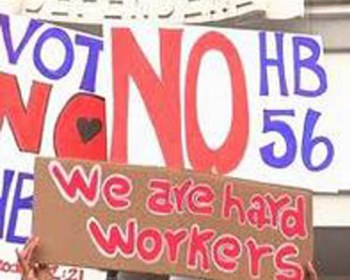
While debates brew and tempers flare over the anti-immigration law in Arizona, many other states have quietly passed some of the most radical pieces of anti-immigration legislation to date. Most alarming is Alabama’s. More radical than the Arizona law, this law strikes even more deeply at the basic rights of immigrants, and appears to have the underlying goal of bringing the immigration discussion to the national stage in a very loud and reckless way.
Provisions of the law (HB-56) include:
- Similar to the Arizona law, it makes it a crime for “undocumented immigrants to be without the required documents,” and makes it a requirement of law enforcement officers to “attempt to determine an individual’s immigration status during a ‘lawful stop, detention or arrest’ when there is ‘reasonable suspicion’ that the individual is an illegal alien” (from law).
- Parents will have to report their residency status and their child’s residency status when enrolling their child in school. Illegal immigrants will be allowed to attend schools, but schools will report the information collected to the state.
- A ban on illegal immigrants attending any public college or university
- A ban on transporting, harboring, or renting property to undocumented immigrants.
- Employers will have to check all potential employees through Everify before hiring, and will be fined if they do not.
- A ban on businesses taking tax deductions on wages paid to illegal immigrants.
The first provision, which is similar to the Arizona law, is extremely alarming as is. Many have labeled it as a form of racial profiling, and even the Arizona Supreme Court declared in United States v. Brignoni-Ponce, “enforcement of immigration laws often involves a relevant consideration of ethnic factors.” This suggests that the Arizona law requires some evaluation of ethnicity in order to be effective, and implies that illegal and legal immigrants will most likely be viewed in the same light, and treated the same. In this way, both the Arizona law and Alabama law allow for some form of discrimination on the part of law enforcement officials, though the Alabama law takes it a few steps further.
The provision in the Alabama law requiring families to verify their residency status to schools has startling implications for children attending schools. If a child were born in the United States (and thus a citizen), but had parents who were illegal aliens, his parents would have reason not to send him to school so as to not expose their immigration status to the state. If the child and his parents decide to risk it anyways and have the child go to school, they face further risks. The child cannot drive his parents anywhere for fear of violating the “ban on transportation” clause in the law, and if the parents drive the child to school, they face the risk of being pulled over under “reasonable suspicion” of being an illegal alien. Because of these risks, many will most likely not go through the trouble. If an illegal immigrant does stay in school though, he faces the problem of being already profiled by the school as an alien, and once graduating, receives the slap in the face of not being able to attend any public college or university. Again, many may not deem it worth it to go through all the trouble and then not even be able to attend college. In these ways, the Alabama law is directly discouraging children from receiving an education.
A lawsuit filed against the state of Alabama regarding a parent adopting illegal immigrant children highlights further implications of this law. The plaintiff in the case adopted two children who were illegal immigrants. He went through the adoption process, which took only a few weeks. Because the waiting process for adopted children to obtain legal status ranges from 1-3 years though, the plaintiff, an American citizen, would be unable to drive his children anywhere when this law is in effect for fear of being seen as “harboring” illegal immigrants. While merely taking care of his children, this man could receive a fine and potentially a blemish on his record. Because of such consequences, this law largely makes the adoption of illegal immigrants illegal.
Supporters continually point to the benefits of job creation, but from a business standpoint, the benefits might not even be that great. Because of the harsh restrictions, companies will now be giving workers much higher salaries to do jobs that illegal immigrants did for much cheaper. Jobs may increase to a degree, but businesses will undoubtedly scale back on the number of workers they hire because of the higher wages they must dole out, and at the same time, prices of products may increase, as the costs of production for businesses increase. With more legal workers but less workers than before, output may drop in many farms or factories, and this paired with rising prices could potentially lead to huge problems in today’s economic climate.
Many throughout the state oppose this bill on the simple base that it would render the idea of being a “good Samaritan” illegal. Giving an alien a ride to work or giving them a place to sleep would now be illegal in Alabama. This will undoubtedly spark racial profiling, as anyone who may be suspected of being an illegal immigrant, or in many cases, anyone who appears to be Hispanic, will be refused rides, a home to rent, or even a home for the night, even at places like churches or temples.
In a state with the lowest population of foreign born citizens (2.9%, with many of them being legal – according to recent census data), why such extreme measures? This bill passed by an overwhelming majority in both the Alabama State House and State Senate, where Republicans hold commanding majorities. Voting largely went along party lines, and maybe in this lies the answer. This issue is quite obviously a political one, and in Alabama, Republicans saw an opportunity to yet again highlight the hypocrisy of their own party. While continually clamoring for small government in fiscal situations, in social situations like immigration, Republicans did not even blink as they used “government” to decide who and who cannot attend school, who and who cannot help who…but I digress.
In general, this law seems to be attacking the immigration problem at the completely wrong angle. Laws like these discourage immigrants from phoning in crimes to the police in fear of being deported, discourage them from attending schools, and discourage others from helping them. With other states like Georgia, Florida, and of course, Arizona, passing similarly extreme anti-immigration laws though, it appears that this trend may continue. All one can do is hope that measures such as Delaware’s proposed version of the DREAM Act can help turn the conversation in a different direction, and wait for President Obama to realize what type of injustice is occurring throughout this country.

Elections for the 2011-2012 Columbia University College Democrats Board will be on Wednesday, April 27th at 9pm in Satow on the 5th floor of Lerner. V&T dinner will be provided and we will have both vegetarian and vegan options. We’d love to have high participation in the elections, so please consider attending or voting absentee!
If you have any questions, please email the Columbia Democrats Council of Elders at [email protected].
Last night I attended an incredible event the Dems cosponsored called Raising Women’s Voices, where several women’s health advocates elucidated relevant parts of the new-ish healthcare bill for young women. They unpacked several confusing aspects of the bill, like the concept of “aging out,” state run plan exchanges, and advancements for women. Below is a condensed “What I Learned” package, all nice and kitchen-table-bonding-with-your-parents-like.
Aging Out: Before healthcare reform, citizens could no longer be covered by their parents’ plans after a certain age (usually around 23). This “aging out” time has been bumped to age 26, regardless of dependent and even marital status. (Yes, this means that married citizens can still be on their parents’ health care plans as long as they’re under 26. But sorry, spouses! No mama and papa health care for you!)
State Run Exchanges: Basically, under the new law, the government has set up a system in which you can shop for more affordable or better health care plans in an exchange setup (exchange as in a commodity market, not exchange as in something that involves a trade in of one insurance for another, or hipster gear). These exchanges will require that each state set up a website and telephone hotline to help individuals and small business purchase qualified health plans. There is also now a better standard for what these plans have to offer as a minimum.
Things That Affect Us Lady Folk: While sadly birth control is still not mandated for free coverage because it’s not considered “preventive” (read: things that make me do this), there are advancements for women in the healthcare bill. First, being a women is no longer considered a pre-existing condition; that is, gender rating is now illegal. (Yay!) Maternity coverage is mandated. (Yay!) Birthing centers are covered by insurance. (Yay!) And “some preventive services” will be covered for women. (Uh…what?) Bad things: abortions still can’t be federally funded or subsidized, many birth control options are not covered or covered enough, and abortion coverage is separated from overall health coverage (meaning you have to send two separate checks for each service for each billing period, an unnecessary obstacle), and community health centers that provide abortion services cannot receive federal funding. So boo, boo, and double boo to those.
As Janine blogged earlier in the year, there is still a fight against reproductive choice for women being waged furiously by the right in many states. Health care reform is far from perfect (and hopefully far from over), but it’s important to know what our new rights are, limited though they may be.
Sign the petition (http://www.raisingwomensvoices.net/contracpt-is-preventn-petition/) to get involved!
